
|
Please note that terminology in my review is used in the same manner as Gary Burton did in the course. Various methods and schools can use other synonymous names: (guide tone lines vs. voice leading, altered vs. super-locrian, etc.)
Despite the course’s name, it reffers only to JAZZ improvisation and some basic knowledge is necessary to make the best use of the material.
Prerequisites:
Lesson 1
The first lesson is about analogy of music and spoken language. When we improvise we should present coherent statements about the song/theme to communicate with audience. In order to do that we must learn the language of music: vocabulary, grammar and correct syntax.
Without mastery of these basics, we can only learn single words and phrases: scales or so called bebop licks (as suggested by many educational publications). Then, our musical statements will only resemble the formula from "Tourist's Phrasebook" We will not be telling a story with our instrument and we will lose interest of our listeners quickly. What are those analogies more specifically: Musical vocabulary - in other words notes/pitches forming chords and scales Music grammar - includes harmony and chord progressions The syntax of music - the form and nature of the piece, which must be understood and described by our improvisation through the motivic work, phrasing and building the solos over longer forms. Lesson 2The Scales - knowing well 10 basic scales will allow us to improvise in 90% of musical situations. 7 Modal Scales - arranged from the "brightest" to the "darkest" mood and from containing most sharp notes to most flats. Lydian, Ionian, Mixolydian, Dorian, Aeolian, Phrygian and Locrian, each following scale gets one more flat note than previous one: 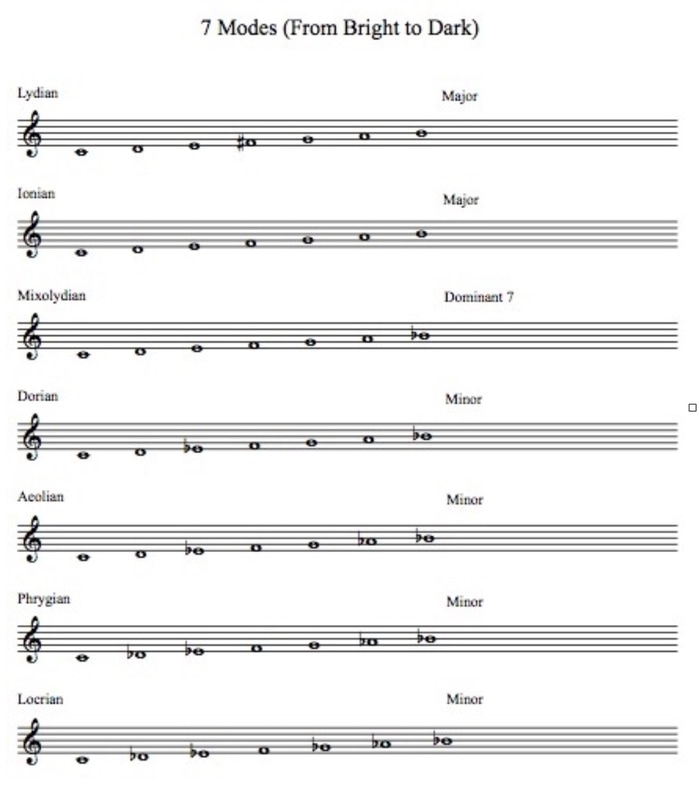
and
3 more Dominant scales: Lydian b7th, Altered scale and Diminshed Symetrical Half-Whole tone scale: 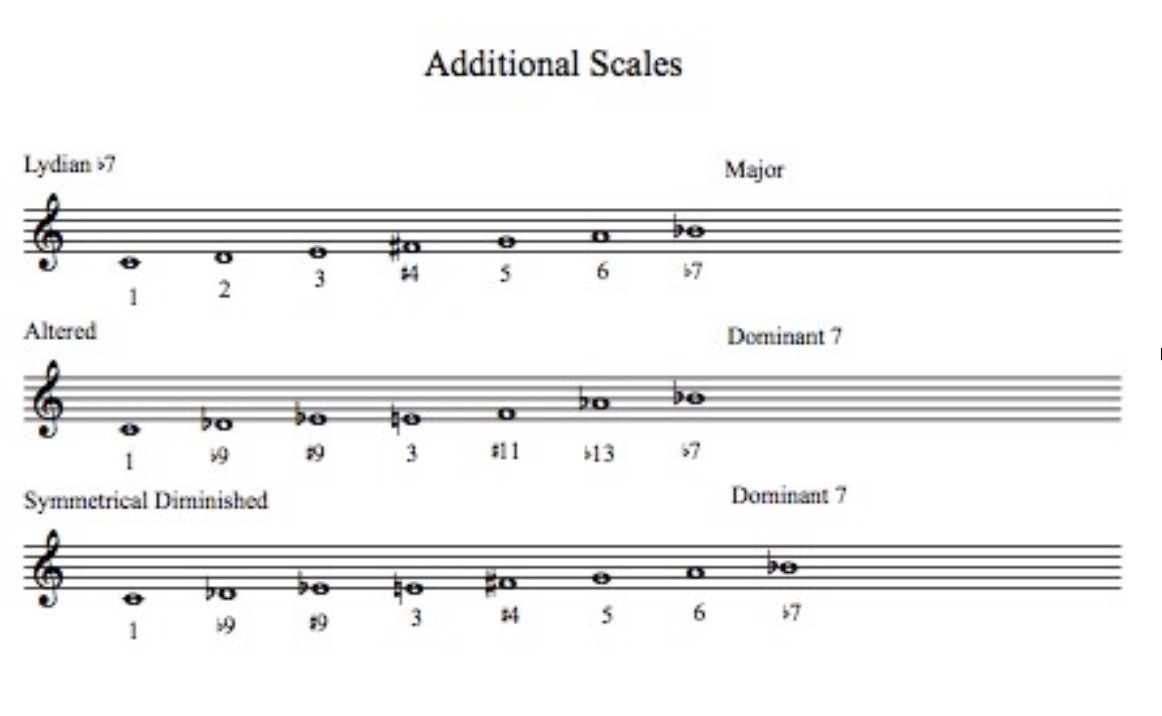
Please note that during the course it will be necessary to know the melodic minor scale as well. (jazz melodic minor) How to use the scales in improvisation - of course, it is not about playing them from top to bottom and back. We should rather treat them as sets of notes to be used in specific ways in given harmonic situations. Good scale mastery allows the free use of various combinations of the scale notes in the whole register of our instrument. In various tempos and rhythmic values. So that typical scale runs must be mixed with sequences of various intervals, melodic figures, arpeggios etc. In general anything we play should emphasize the notes that are characteristic for the actual scale (chord). I like to think of a scale as of a „sack” with notes which I need to have prepared at some point and then the creative process may begin - what can I build from them? Check my assignments from 2013 on above mentioned subjects. Ons exercise we got tom Gary Burton is how to treat the scale in creative manner and how to learn it all over your instrument: Summary of lessons 3 and 4 will appear next week
In the next lecture, Gary Burton shares with us his excellent method of choosing quickly, "on the fly”, tthe right scale for given harmony of the song.
On the fly -means without preparation in advance, at sight, in real time during a trial or jam session. This method is actually very interesting and effective. It is based on answering to one or max two questions for each chord situation. Watch my blog to get a notice when I post it
0 Comments
Leave a Reply. |
 RSS Feed